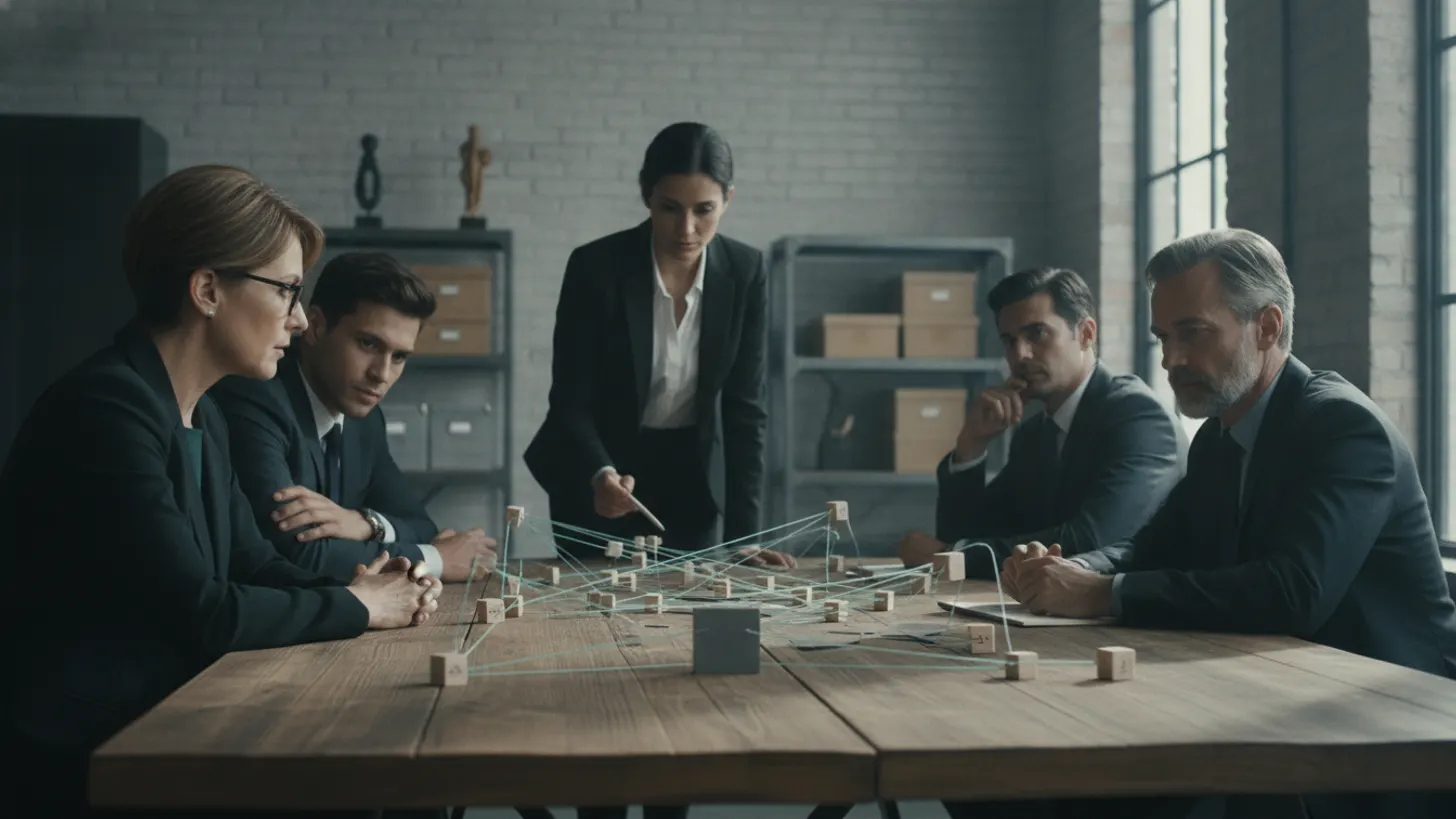
"Who actually signs this?" is the question most sellers ask by week three, and it is the wrong one. A B2B buying committee does not sign; it withholds. The economic buyer approves what the group has already agreed to, and the group agrees only once each member's private objection has an answer. Map the objections rather than the org chart and approval stops looking like luck.
Why the economic buyer is rarely the whole B2B buying committee
Seventy-seven percent of B2B buyers call their most recent purchase very complex or difficult, Gartner found, and the reason is structural: the economic buyer holds the budget, not the veto. Approval travels last through a B2B buying committee because the people who can block a purchase sit in security, finance operations, and the team that will have to run the thing. Sell to the signature and you lose in the pre-read.
Group size is where most pipeline models go wrong. Gartner's research on the B2B buying journey puts a typical complex purchase in the hands of six to 10 decision makers, each arriving with a different shortlist and a different reason to stall. That complexity figure is not a complaint about vendors. It is a measure of what it costs a company to agree with itself.
Harvard Business Review's account of the consensus sale draws the sharper conclusion: the hard part is not convincing the champion, it is getting a group that disagrees about the problem to settle on one version of it. Persuasion aimed at a single buyer does little when four colleagues each hold a separate definition of what is broken.
Forrester's research on B2B buying groups shows the same structure from the information side. Cross-functional stakeholders need different evidence for one decision: the operator wants a migration plan, finance wants a payback window, security wants a control list. A single generic case study answers none of them. If your account plan still names one contact, you do not have a selling problem, you have a gap in the decision layer.
How to map roles across a B2B buying committee
Six roles cover most high-consideration purchases, and mapping them means mapping by decision, not by title. Every member of a B2B buying committee owns one question the group cannot settle without them, and a useful map records that question, the evidence that answers it, and whether anyone has supplied it yet. Titles vary between accounts; the questions barely move.
One person can hold two of these roles, and in smaller companies the founder holds four, but the questions still have to be answered separately. The table below is the working version of a committee map: role, the decision they own, the evidence that moves them, and the signal that tells you they have actually been reached.
| Role | Decision they own | Evidence that moves them | Signal you reached them |
|---|---|---|---|
| Economic buyer | Is this worth the money now | Payback window, cost of doing nothing | They set the review date |
| Technical evaluator | Will it work in our stack | Architecture notes, integration list | They ask about edge cases |
| Operator or end user | Who runs this on Monday | Migration plan, training load | They volunteer a workflow |
| Finance or procurement | Are the terms acceptable | Pricing model, contract precedent | They send their paper first |
| Security and legal | What risk are we taking | Control summary, data handling | They return a scoped questionnaire |
| Champion | Is this worth my credibility | Internal business case they can send | They forward it without editing |
Start the map from the account's shape rather than from your CRM contacts. The same product sold into a 40-person company and a 4,000-person company meets different groups, which is why segmentation work on firmographics and real buyer needs pays off here: it tells you in advance which roles to expect before you have met anyone.
Which signals reveal hidden blockers and internal champions
Three signals carry most of the information about a hidden blocker in a B2B buying committee, and none of them look like an objection. Secondhand concerns come first, scope changes arriving after the demo come second, and silence after an internal meeting is the third and most reliable. Blockers rarely announce themselves; read the shape of the delay and you can usually name the person behind it before anyone introduces you.
Each signal has a specific tell. Secondhand objections show up when your contact relays a concern they cannot defend or expand on, which means it came from someone you have not met. Scope changes show up when a requirement appears after the demo, which usually means a function reviewed the deal privately. Silence after an internal meeting is the hardest to read and the most reliable of the three.
Champion signals run the other way. A champion asks what they should say, not what you will say. They request the business case in a format they can forward, they warn you about internal politics, and they put their own name on the recommendation. McKinsey's growth, marketing and sales research keeps landing on the same mechanism: suppliers win when they reduce the internal work of buying, not when they add another touchpoint.

How to personalize messaging by role without splitting the story
Write one argument and four appendices. The group has to reconcile everything you send into a single recommendation, so the core claim about what is broken and what it costs stays constant, while the evidence attached to it changes by role. Four narratives give the committee four things to disagree about.
In practice that means a shared problem statement plus role-specific artefacts: a payback model for finance, a control summary for security, an implementation plan for the operator, and a one-page internal case the champion can forward without editing. Think with Google's research on B2B buyer behavior points in the same direction, describing buyers who are largely self-educating before they ever speak to a supplier, which means the role-specific material has to be findable rather than delivered in a meeting.
This is also where marketing and sales fall out of step. Marketing writes for the persona it can reach cheaply, which is almost always the champion, while the blocker reads nothing the company publishes. Getting both functions working from one buyer journey is what stops the committee receiving two incompatible versions of the same pitch.
What metrics show B2B buying committee coverage is improving
Four numbers are enough to run on, and coverage itself is a count, not a feeling. The metric that matters is how many of the expected roles in a deal of this shape have been identified, reached and answered, tracked as a share of open opportunities by stage. Contacts per account measures list hygiene; roles per decision measures risk.
Each of those four numbers maps to a failure you can act on in a B2B buying committee:
- Share of open opportunities with three or more roles identified and reached, by stage.
- Median days between first contact and second stakeholder engaged.
- Share of closed-lost deals where a role appeared only in the final month.
- Share of deals where security or finance was engaged before the proposal.
Those metrics belong in the forecast, not in a separate marketing report. A single-threaded deal at proposal stage is not an 80% deal regardless of what the stage definition says, which is the argument for building pipeline data you can make decisions from. Bain's commercial excellence research makes the broader case that committed buyer behavior, not supplier activity, is the signal worth tracking.
Where B2B buying committee mapping goes wrong
We lost a deal in week nine to a reviewer we never met, at a 140-person logistics software company we advised in 2024, and that is where we learned this lesson ourselves. We had spent two months building the case with one enthusiastic VP of Operations, treated him as the whole committee, and never asked who else could say no. The map we had was a contact list with extra columns: six names on the opportunity, no open question recorded against any of them, nothing in our outreach that changed because of what we knew.
The deeper mistake was timing. By the time our proposal existed, the B2B buying committee had already formed its private view, and BCG's commercial publications make the same point repeatedly: the work has to happen while requirements are still being written, not after. We also used to let our champion do the mapping for us, which turned one person's view of the account into our whole picture of it, blind spots included. We do not run accounts that way now.
Frequently asked questions
How many people are usually on a B2B buying committee?
Gartner's sales research puts a typical complex purchase in the hands of six to 10 decision makers, and enterprise deals often run wider than that. The count matters less than the spread. The group is cross-functional by design, so a finance view, a security view and an operator view are all live at the same time, and any one of them can hold the deal indefinitely. Treat an open opportunity with a single named contact as unmapped rather than simple, and go looking for the other five before you put a date on it.
Who is the real decision maker in a B2B deal?
Usually there is not one. Harvard Business Review's work on the consensus sale found that the binding constraint is group agreement about the problem, not the approval of whoever signs. The economic buyer ratifies a decision the group has already reached, which is why late pushback almost always comes from someone who was never in a meeting. The practical answer is to find the people who can stop the purchase on their own. That list is different from the list of people who can start it, and it is usually shorter.
How do you find the hidden blocker in an account?
Watch for objections that arrive secondhand. When your champion returns with a security concern they cannot explain, or a procurement requirement that appeared overnight, someone outside the room is shaping the deal. Forrester's commentary on buying groups describes stakeholders with different information needs, and an unmet need surfaces as delay rather than as a complaint. Ask directly who else reviews a purchase like this, ask what would make them say no, then write a document for that person. A blocker who receives their own answer often stops blocking.
Should marketing build content for every stakeholder?
Not for every stakeholder, but for every unresolved question. McKinsey's growth, marketing and sales practice returns to the same finding: buyers reward suppliers who make the internal case easier to carry. In practice that means a small set of role-specific assets, such as a security control summary, a payback model and an implementation plan, all sitting under one shared narrative. Three sharp documents beat a dozen variations of the same deck, because the group has to reconcile whatever you send into a single recommendation.
What is the difference between a champion and a coach?
A coach explains how the account works. A champion spends their own credibility arguing for you when you are not in the room. Both are useful, and confusing them is how forecasts go wrong, because a friendly coach feels like progress while nothing actually moves. Bain's commercial research points at the same gap between supplier activity and committed buyer behavior. Test for championship directly: will this person introduce you to finance, share the internal evaluation criteria, or send your business case to their boss? If not, you have a coach.
How do you know if committee coverage is improving?
Measure named roles per open opportunity rather than contacts per account. Count how many of the roles you expect in a deal of this shape have been identified, reached and answered, then track the share of opportunities clearing all three at each stage. BCG's commercial research ties pipeline quality to this kind of account-level discipline rather than to volume of activity. Improvement looks like fewer single-threaded deals, shorter gaps between first contact and second stakeholder, and fewer late-stage losses attributed to a person you never met.