Growth flattens. The meeting follows a script. Someone proposes raising the budget, someone else proposes a new channel, and the plan for the quarter becomes more of what already exists.
Sometimes that is right. Often it is the most expensive way to find out that the problem was never demand.
Three places the constraint can sit
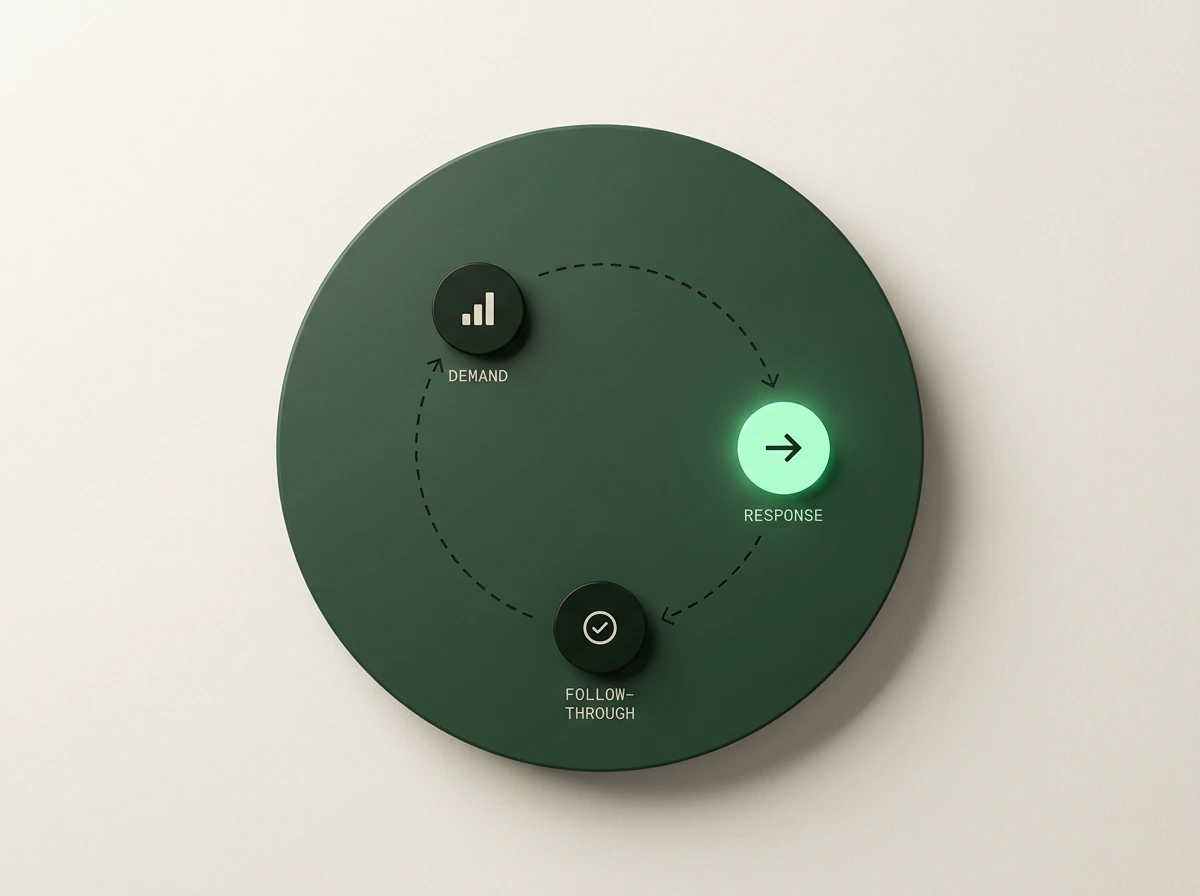
Acquisition is a loop, not a line. Money bought at the top only converts if the two steps behind it are ready.
- Demand Are enough of the right people arriving at all. This is the only part more budget fixes directly.
- Response When they arrive, does the path from interest to action hold together. Message, page structure, offer clarity, the length of the next step.
- Follow-through For everyone who does not act immediately, does anything useful continue after the first visit.
Spending more on demand while response is broken is buying tickets to a show that is not ready. It works only in the sense that more people see it fail.
The arithmetic nobody writes down
Every acquisition plan multiplies three numbers: how many qualified people arrive, what share of them take the next step, and what share of the rest come back. Growth is the product of all three, which is why the largest available gain is usually in whichever number is weakest, not in whichever number is easiest to buy.
Demand is the easiest to buy, so it is the one that gets bought. That is the whole trap in one sentence.
Find the constraint before you fund anything
You can usually locate it in a morning with data you already have.
- Count how many qualified people reached the point of action last month, not how many visited. If that number is healthy and revenue is not, the constraint is later than demand.
- Walk your own buying path on a phone as a stranger would. Note the first moment you have to guess something. That guess is friction and it is measurable.
- Look at what happens to people who came close and did nothing. If the answer is nothing, follow-through is your cheapest available move.
- Ask sales which enquiries they wish they had more of, and check whether the current spend is buying those or the easy ones.
Extra spend makes an existing pattern louder. It does not change what the pattern is.
Three questions that locate it
If the audit above is too much for the time you have, three questions get you most of the way.
- Would more of the same help If you doubled arrivals tomorrow with the current path unchanged, would sales be pleased or overwhelmed by unqualified conversations. The honest answer tells you whether the problem is volume or quality.
- Where do people stop Find the last step most people complete and the first step most people abandon. The gap between those two is the friction, and it is usually one page or one form field wide.
- What happens to the nearly ready Ask what a person who visited twice and did not enquire receives next. If the answer is silence, you have found unpaid demand you already own.
What to do in each case
If the constraint is response, the work is clarity: what the page promises, how the offer is framed, how many steps stand between interest and a conversation. Changes here compound, because every future dollar of demand lands on a better path.
If the constraint is follow-through, the work is sequence and timing: what a person who is close but not ready hears next, and when. This is usually the least glamorous and best value work available to a growing company.
If the constraint really is demand, then more spend is the right answer, and now you can scale into a path that holds instead of scaling into a leak.
When more demand really is the answer
This is not a rule against spending. There are clear cases where buying attention is exactly right: the path converts at a rate sales is happy with, follow-through exists and runs, the offer is proven with the audience you want more of, and the constraint is simply that not enough of the right people know you exist.
In that situation, hesitating is its own kind of waste. The point is that you can now say why the spend is the right move, which also means you will know quickly if it stops being right.
Sequencing a quarter
A practical shape for the next ninety days, when the constraint is not demand: spend the first few weeks on the response path, because it changes the value of every dollar that follows. Put the middle of the quarter into follow-through, since it works on demand you have already paid for. Then scale spend in the last stretch, into a path that now holds.
The order costs nothing extra. It just refuses to buy attention before there is somewhere useful for it to land.
How to argue this internally
Saying no to more budget is harder than saying yes, so it helps to have the argument ready. Not a defensive one, a commercial one.
The case is that the same money buys more later. Improving the path lifts the return on every future dollar rather than only the dollars spent this month, and it is measured on demand you already have, so the evidence arrives faster than a new channel test would produce it.
Put a date on it. Agree that response and follow-through get a fixed window, that a specific threshold decides whether the path is now ready, and that spend increases the moment it clears. That turns a disagreement about priorities into a sequence everyone can hold. It is the same discipline a decision layer brings to the whole budget, applied to one question.
The order matters more than the effort
None of this is an argument against paid media. It is an argument about order. Fix the buying path, make follow-through real, then buy attention on purpose.
Teams that work in that order tend to spend less to get further, and they can explain why the next investment is the right one. That explanation, more than the budget, is what makes growth repeatable.
Frequently asked questions
Why is my website getting traffic but no sales?
Usually because the constraint sits after demand. Traffic shows that people are arriving, not that the path from interest to action holds or that anyone follows up with the people who came close. Count how many qualified people reached the point of action last month, then walk your own buying path on a phone as a stranger would.
When is it right to increase ad spend?
When the path already converts at a rate sales is happy with, follow-through exists and runs, and the offer is proven with the audience you want more of. At that point the only constraint is reach, and holding back is its own kind of waste. Before that point, extra spend makes the existing leak bigger.
What does follow-through mean in acquisition?
It is everything a person receives after showing interest without acting: the next email, the reminder, the reason to come back. Many businesses send nothing, so demand they already paid for simply disappears. Fixing it is usually the cheapest gain available, because it works on people who have already arrived.
How long should you work on the buying path before scaling spend?
Set a fixed window and a threshold in advance. A workable shape for a quarter is the first few weeks on the response path, the middle on follow-through, then more spend in the last stretch. Spend goes up the moment the agreed threshold clears, so the sequence cannot turn into an open-ended delay.
Want an independent read on your growth plan?
A short call on what to fix first, what to fund next, and what to stop paying for.