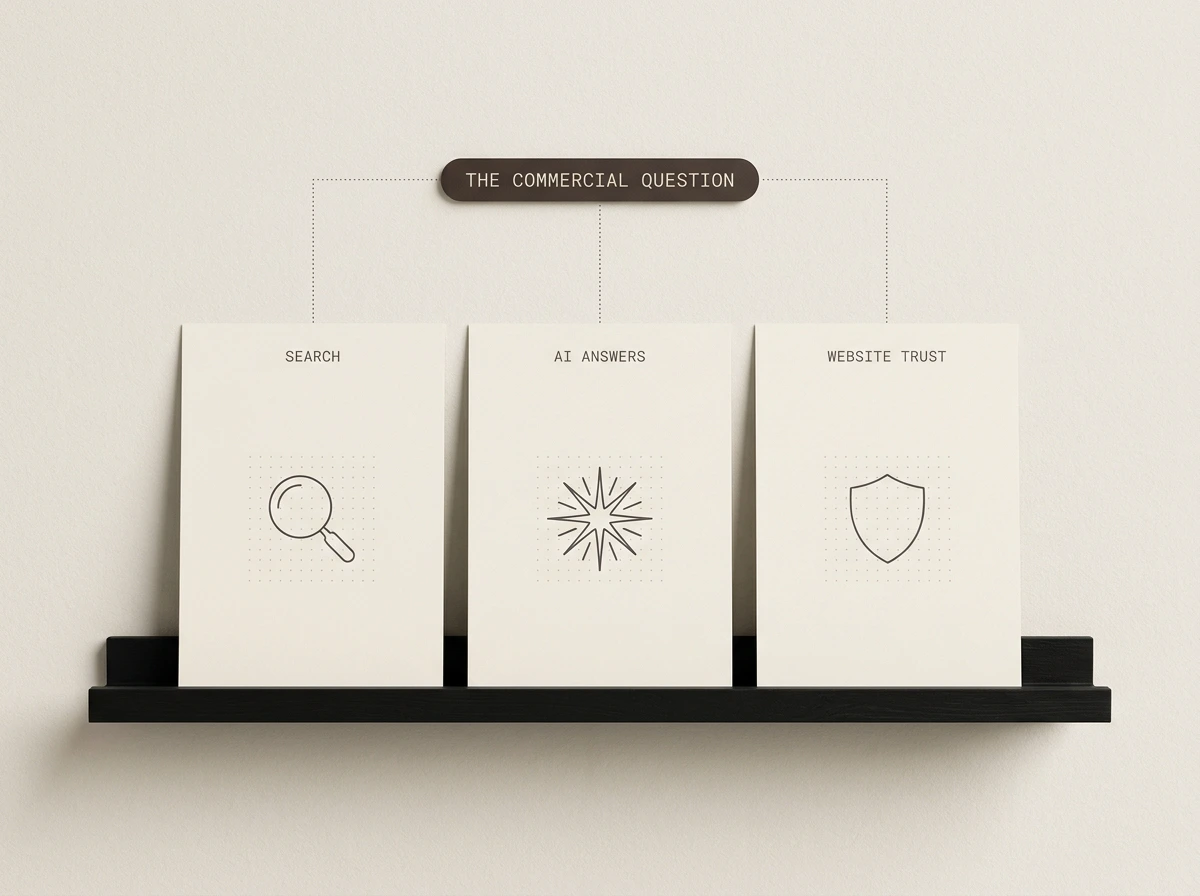
A buyer with a real problem does roughly the same thing everywhere. They search. They ask an answer engine to summarise the options. They open two or three websites and decide within a minute whether anyone here understands their situation.
Those three surfaces are not a funnel. Nobody is required to start at search and finish at your homepage. They are three windows onto the same business, opened in whatever order the buyer feels like, often within the same ten minutes.
Which is why the most common visibility problem is not absence. It is disagreement.
What disagreement looks like from the outside
The search result describes a service. The answer engine describes a slightly different company, assembled from an old case study and a directory listing. The website leads with a positioning statement written after both of those were published. Each source is defensible on its own. Together they read as a business that has not decided what it is.
The buyer does not diagnose this. They just feel less certain, and certainty is what they came for.
Consistency is not a branding preference. It is the cheapest form of credibility a business can buy.
How the three drift apart
Nobody plans this. It happens because the surfaces are built at different times by different people with different briefs.
The site gets rewritten when the positioning changes. The old blog posts stay where they are, because deleting them feels like losing traffic. Directory profiles were filled in years ago by whoever set up the account. Case studies describe the business as it was when the work was done. Every one of those artefacts is a source, and an answer engine reads them all with equal seriousness.
So the drift is not a content problem. It is a maintenance problem that nobody was assigned.
Start from the commercial question
Before auditing anything, write down the question your best buyers are actually asking. Not the keyword. The question. Something like: who can help us decide what to fund next, or how do we choose a partner without another six weeks of meetings.
That question is the thing all three surfaces have to answer the same way. Everything below is a check against it.
What each surface is doing
- Search Search is where demand that already exists goes looking. The job is coverage of the real questions and a route from the answer to the next step. Useful answers first, the click second.
- AI answers Answer engines assemble a description of you from whatever sources they can read and reconcile. The job here is source clarity and consistency, so what they find agrees with itself. Nobody can promise a citation, and anyone who does is selling something they do not control.
- Website trust The site is where attention becomes understanding. The job is evidence: what you do, who it is for, what happens next, and proof that you have done it before. Clarity beats volume every time.
A two-hour audit anyone can run
You do not need a tool to find most inconsistencies. You need an afternoon and a willingness to read your own business the way a stranger would.
- Ask an answer engine to describe your company in three sentences, then read those sentences next to your homepage headline. Note every place they disagree.
- Search the commercial question your buyers ask. Look at what ranks and ask whether your version of that answer is more useful, not just longer.
- Open your site on a phone and time how long it takes to find what you do, who it is for and what the next step is. If it takes more than fifteen seconds, that is the finding.
- List every source an engine could be reading about you: the site, directory profiles, old press, partner pages, social bios. Check the description each one carries.
- Fix the disagreements before publishing anything new. New content on top of an inconsistent base makes the inconsistency louder.
Fix in this order
When the audit produces a list, resist the urge to work alphabetically. Order matters, because each step makes the next one cheaper.
- Decide the sentence Write one sentence that says what you do, who it is for and what makes the choice easy. Everything downstream is a version of this sentence at a different length.
- Fix the site first The site is the only surface you fully control and the one every other source eventually quotes. Correcting it first means later corrections have something true to point at.
- Correct the loudest third-party sources Profiles, listings and partner pages that rank for your brand name. These are usually a morning of edits and they remove most of the contradiction.
- Then publish New content is worth writing once the base agrees with itself. Before that, publishing adds volume to a story that is still arguing with itself.
Reference readiness, not guarantees
It is worth being precise about what this work does and does not do. Making your sources clear, consistent and easy to parse improves the chance that an answer engine describes you accurately when it describes you at all. It does not guarantee that you appear in any given answer, and results move as the engines change.
That honesty matters commercially. Visibility work that is sold as a guarantee tends to be measured against a promise nobody can keep, and gets cancelled just as the structural work starts paying off.
What to watch once it is consistent
Consistency work is hard to celebrate because the win is an absence: nothing contradicts anything. A few signals are still worth watching.
- Whether the description an answer engine gives of you matches your own sentence, checked on a fixed cadence rather than when someone remembers.
- Whether the questions you rank for are the ones a buyer would ask before a purchase, not only the ones that were easy to rank for.
- Whether people arriving from search reach the point of action, since coverage without a route is a vanity result.
- Whether sales hear fewer basic qualification questions on first calls. That is the clearest sign the three surfaces are doing their job.
Set a date to repeat the audit. Businesses change faster than their published descriptions, and the drift starts again the day after the positioning does.
The sentence test
Most inconsistency traces back to a sentence nobody has agreed on. A useful version of that sentence names the buyer, the problem and the mechanism, and it survives being read by someone who does not work in your industry.
A weak version describes a category: we are a growth consultancy helping ambitious brands scale. A strong version describes a decision: we help service businesses decide what to fund next, then bring the specialists to deliver it. The second one gives search something specific to match, gives an answer engine something unambiguous to summarise, and gives a visitor a reason to keep reading.
Write the sentence, then read your three surfaces against it. Anything that contradicts it is either wrong or out of date, and both are fixable in an afternoon.
One truth, three windows
The practical goal is simple to state and harder to hold: whichever window a buyer opens, they should meet the same clear account of what you do, who it suits and what happens next.
Businesses that get this right rarely have more content than their competitors. They have less contradiction.
Frequently asked questions
Why does an AI answer describe my business differently from my website?
Answer engines build their description from every source they can read: old case studies, directory profiles, press, partner pages and the site itself. If those sources were written at different times for different briefs, the summary reflects the mix, not your current positioning. Fixing the sources is what changes the description.
How do you get your business to show up in AI search?
Make every source an engine reads describe the business the same way: the website first, then the profiles and listings that rank for your name, then new content. That improves the chance of an accurate description. Nobody can promise inclusion in a given answer, so treat a promise of citations as a warning sign, not a feature.
What should be fixed first: the website, listings or new content?
The website. It is the only surface you fully control and the one other sources end up quoting. Then correct the loudest third-party sources, usually the profiles and listings that rank for your brand name. Publish new content last, once the base agrees with itself.
How often should you check what AI engines say about your business?
On a fixed cadence rather than when someone remembers, and again whenever the positioning changes. Ask two or three engines to describe the company in three sentences and read the answers next to your own one-sentence description. Every disagreement points to a source that is wrong or out of date.
Want an independent read on your growth plan?
A short call on what to fix first, what to fund next, and what to stop paying for.